Average Reviews:

(More customer reviews)To be perfectly honest, I would never have bought this prior to using it on a review loan from Transcend. I own many Transcend cards in multiple formats and sizes (mostly 32gb) and all perform beautifully; about one bad image per seven thousand: one SDHC for my Sony NEX-3; which shouldn't be underestimated as a profesional level camera, one CF and one SDHC card for my Canon 1Ds III; full frame and BIG for when I'm doing a fancy shoot that doesn't require too much mobility, one SDHC for a portable boot disk (should I not have my laptop and need my workspace on a computer), and one SDHC used with a USB reader as a flash drive (with a few other 8gb, 4gb, and 2gb cards). I got this card as a review unit from Transcend before they released it, and recently bought one myself at a discount from them only for when I go on long trips without my computer. I'm a freelance professional photographer, so in the usual day I'll be doing anything from a product shoot to college sports to a fashion show. Basically, all the small and medium businesses that can't payroll a full time photographer hire ones like me, usually on a regular basis. So I certainly keep myself busy and can rack up thousands of pictures in a day. Before I continue with the full review, I will mention that I used this primarily with my NEX-3, and for about an hour underwater SCUBA in my girlfriend's Panasonic Lumix DMC-TS2. My Canon 1Ds III doesn't support SDXC (sadly).
Capacity: Massive! PRO.
This card is massive beyond all others. 64gb is 4000 14MP RAW pictures. That's absolutely top of the line capacity. 4000 pictures is even above and beyond what I use in three or four large shoots. Usually I use JPEG, which is about a third to a fifth the size of a RAW image. On my NEX-3, it reported 10,250 14MP Fine JPEG pictures, double that (20,500) in 7.1MP Fine JPEG, and double THAT (41,000) in 3.5MP Fine JPEG. All of these are truly ridiculous. But that was for a full APS-C sensor camera at highest possible quality. When I put it in the DMC-TS2 for the first time, I thought it couldn't read the card and freaked, since the "pictures left" indicator just kept flashing. I put it back into the NEX-3 and it was fine. So I figured I'd take a couple shots with the TS2 with the card in and see what happened. Lo and behold, it saved the pictures just fine. I put it into full high speed mode with a specially rigged remote to just hold the shutter button down, and came back about 20 minutes later to see if it showed a number. Eventually it hit 9,999 after it took 2,568 pictures. So this is a card that owns the market on capacity for SD cards.
Speed: Not so fast, CON.
This card starts to fall down when it comes to speed. It gets the Class 10 speeds just fine, but not much more than that. For those that don't know, Class 10 means that no matter what happens to the card short of being completely physically destroyed, it will have at least 10 Megabytes per second sustained write speed. I maxed out the card at burst speeds of around 15MBps, but that's it. It will handle HD video perfectly fine, but it won't write fast enough to use the magical 7fps continuous speed mode on my NEX-3 to the full advantage. It went for 20 JPEG shots at 7fps before slowing down to 2.3fps. It went for only 9 RAW shots at 7fps before going down to 2fps. This is both fault on the only medium sized image buffer, but mostly on the card. My Sandisk Extreme III card can keep up at around 5.5fps on RAW or JPEG continuous speed mode. This isn't a card to buy for the highest speeds, for that get a Sandisk Extreme card. I, II, or III doesn't matter, all are more than acceptable.
Reliability: Among the best, PRO.
This is never a big problem on any big brand memory such as Lexar, Sandisk, Patriot, Kingston, or Transcend. As far as I'm concerned, as long as it's less than one bad image in a thousand I'm fine with the card. I've never ever had a bad image on a Sandisk card, but I haven't used them enough to really tell. I've used them for ~10,000 shots, and none were bad. On Lexar, Toshiba, PNY, A-Data, and Kingston (who's SD cards are all the same) I get about one bad image per two thousand. So not too bad. Patriot does a little better, with one per three thousand. And finally Transcend, which gets one bad per 7000. So image corruption is never something to really worry about, and it's usually the camera that writes bad, not the card. On older or off brand point and shoots I get about one bad per hundred shots.
Value: Absolute worst, CON.
Definitely the worst point on this card. Before another story, I'll spare you: don't buy this card unless you really, really need to or really, really want to. I cringe every time I think about how much I spent on this card. I bought it for use on a week long European backpacking trip with my girlfriend, and neither of us brought our computers, so I needed the card capacity because of that, and I have to say that it served me well for the trip. Did I need it at all? No. Would I have been smarter and better off using a couple 32gb cards? Absolutely. But the peace of mind that came with knowing I couldn't fill it was nice. I did in fact send it back afterwards and bought another 32gb card and a battery each for my 1Ds III and NEX-3. Much better purchase for the money.
Compatibility: Not too bad, but not good either. CON.
SDXC didn't exist a couple of years ago, so unless your camera is fairly new it probably won't support this card. Go to the manufacturer's site and check the product info to be double and triple sure that it works with your camera. No real experience story here, it worked with both cameras I used it with and didn't work with a camera that it wasn't designed to work with.
All in all, don't bother. You'd absolutely be better off buying two 32gb Class 10 cards and an extra battery, or one 32gb card and two extra batteries, etc, than buying this card. I can't see a true purpose for this card other than for size queens or sports photographers; but they're using CF cards. I rated this as it stands as a product, but there is virtually no marketable use for this other than maybe for expandable computer storage, in which case a 1TB portable hard drive is still cheaper. Heck, a 128GB SSD is cheaper than this!
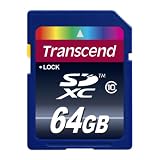
Click Here to see more reviews about: Transcend 64 GB Class 10 SDXC Ultra Speed 25MB/S Flash Memory Card TS64GSDXC10
Featuring 64GB of storage space with the exFAT file system that supports files larger than 4GB, Transcend's Ultimate SDXC Class 10 cards are the ideal complement to today's high-end SDXC-compatible DSLR cameras and HD camcorders. Thanks to its unprecedented amount of storage capacity, the SDXC cards enable extended HD video recording time as well as high-resolution digital photography.Fully Class 10 compliant, Transcend Ultimate SDXC cards boast read speeds up to 25 MB/s. This exceptional data transfer performance not only prevents lag when recording Full HD videos, but also enables high-speed consecutive shooting at fast-motion events. As more and more consumer electronic products are expected to support SDXC in the near future, widespread adoption of SDXC is just around the corner!
 Get 34% OFF

0 comments:
Post a Comment